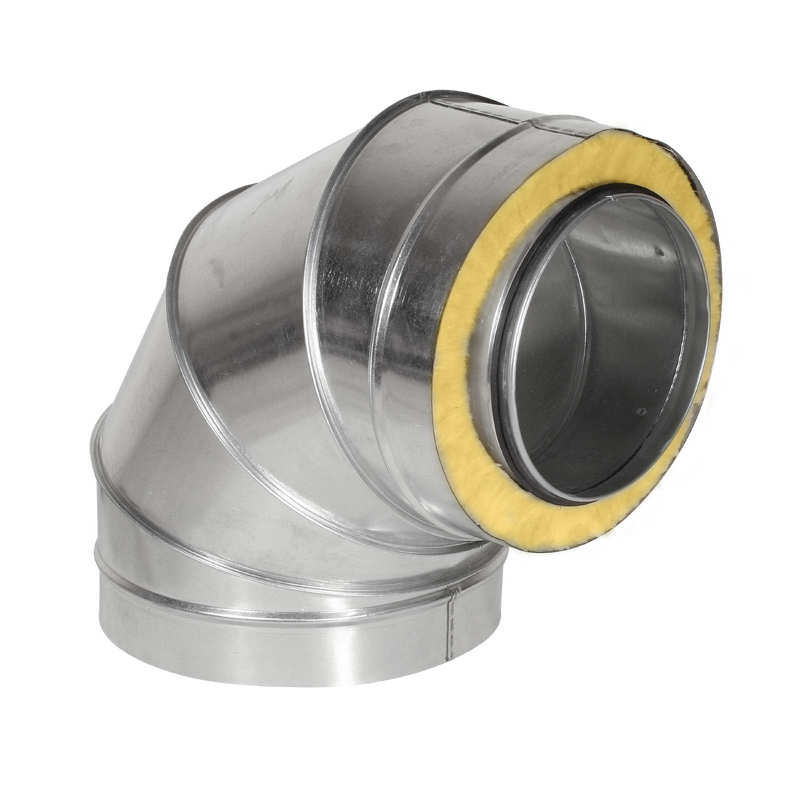
Industry-grade galvanized duct elbows engineered for smooth airflow redirection, high-pressure resilience, and long-lasting performance across all HVAC applications.
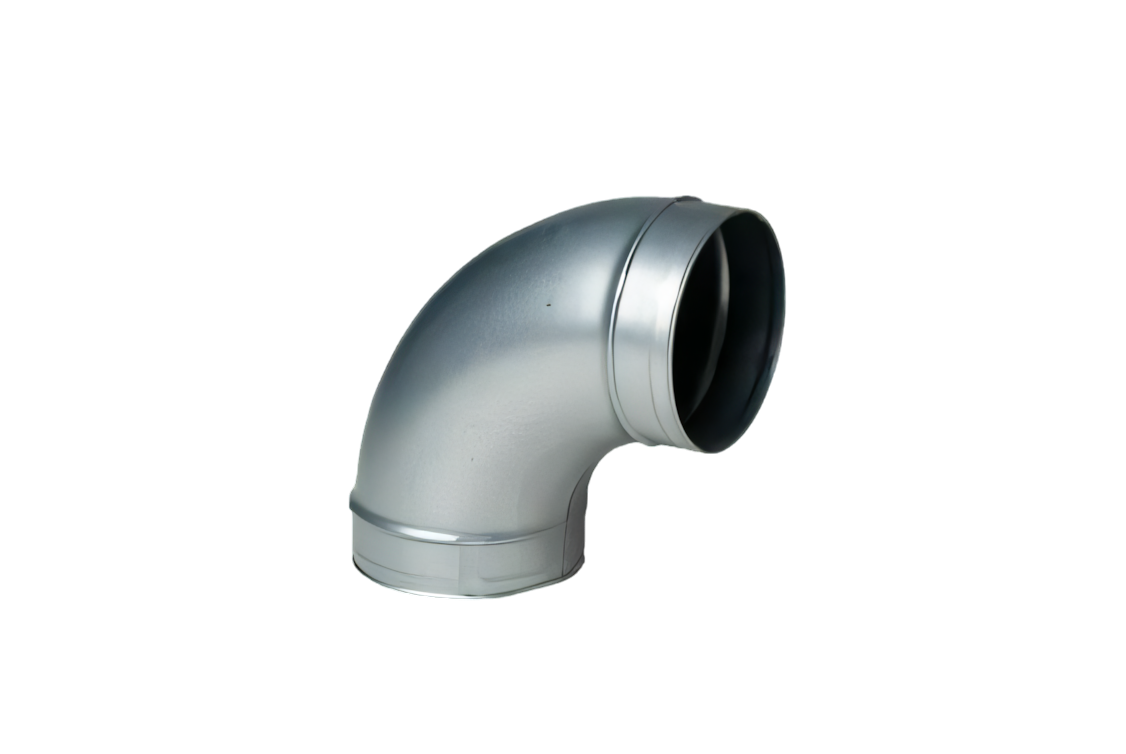
SIDCO manufactures round pressed duct elbows with die-stamped precision and stitch welding from end to end—along both the toe and heel—ensuring zero leakage and maximum structural integrity under any airflow condition.
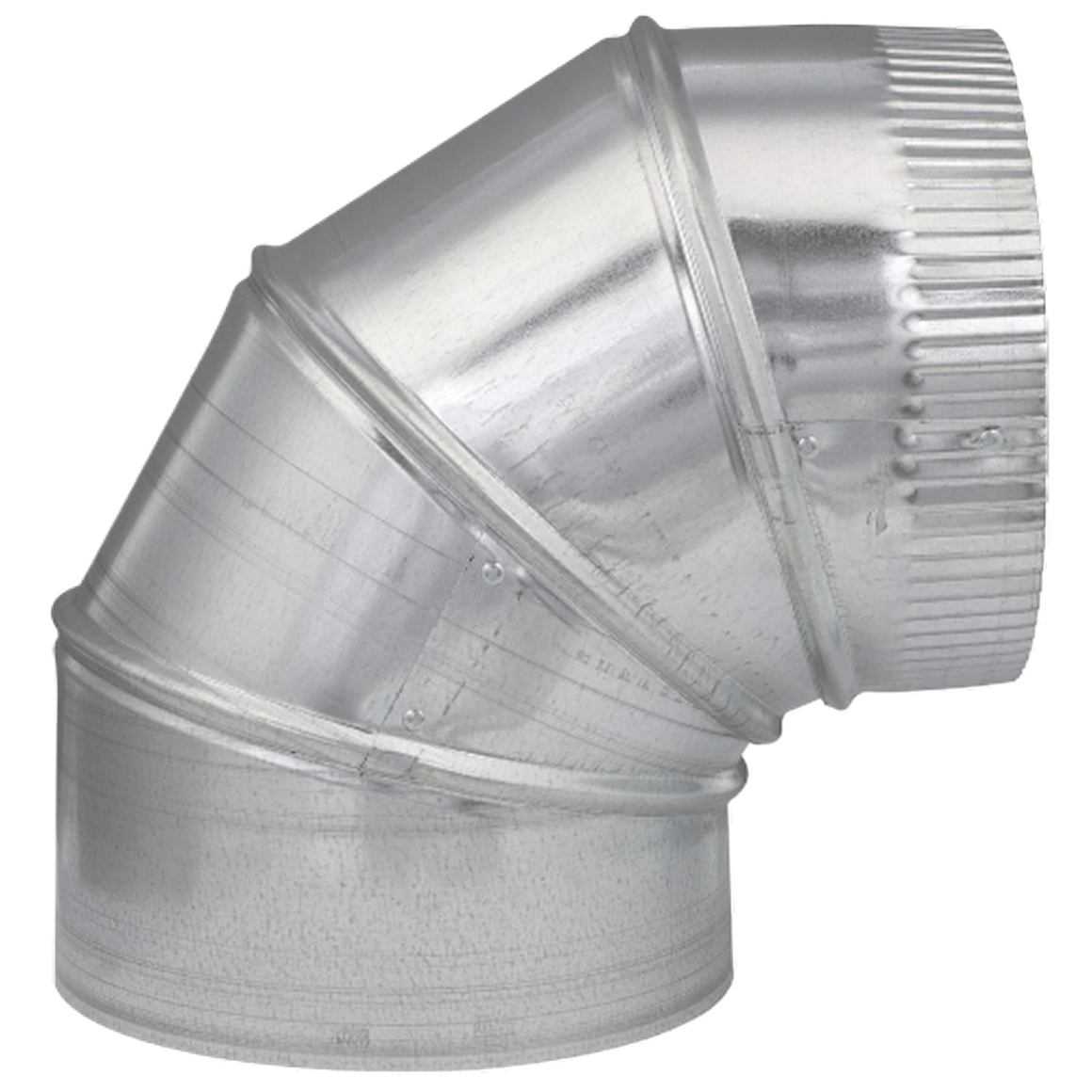
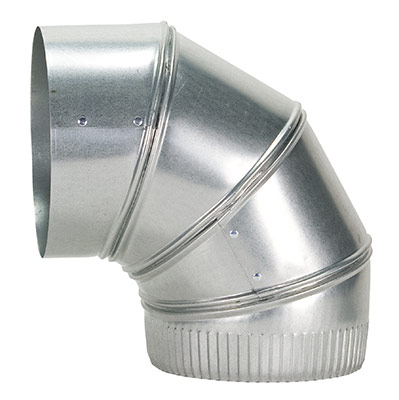
G60 or better Galvanized steel, and Paintgrip steel — both meeting and exceeding ASTM-A653 and A924 specifications for corrosion resistance and durability.
Exceeds SMACNA high velocity and medium pressure requirements — rated from -2 in. WG (negative pressure) up to +10 in. WG (positive pressure).
Die-stamped at 1.5 CLR (centerline radius), stitch welded end to end along both the toe and heel for a watertight, structurally robust seam throughout.
Standard 90° elbows for right-angle turns, and 45° elbows for diagonal routing — both available in 1.0 CLR and 1.5 CLR across all diameters from 4" through 24".
22-gauge steel across all standard diameters — meeting or exceeding SMACNA requirements for gauges at each size, ensuring reliable performance without unnecessary weight.
Every elbow is inspected prior to shipment. We conform to ASTM-A653/A924 and SMACNA standards, ensuring consistent quality and performance on every order.
Two centerline radius options across a full 4" to 24" diameter range — built for every commercial, industrial, and mechanical application.
Our most popular elbow configuration. The 1.5 CLR (centerline radius = 1.5× the duct diameter) delivers lower pressure drop and smoother airflow compared to tighter radii — ideal for most commercial HVAC systems where space permits a wider turn.
The 1.0 CLR (centerline radius = 1× the duct diameter) is designed for tight-space installations where a full 1.5 CLR turn won't fit. Perfect for mechanical rooms, confined ceiling cavities, and retrofit applications with limited clearance.
Right-angle airflow redirection for main duct transitions and branch connections. Available in both 1.0 and 1.5 CLR, 4" through 24" diameter, stitch welded toe-to-heel for a leak-resistant seam.
For diagonal duct routing and gentle directional changes. Lower static pressure drop than a 90°. Available in both 1.0 and 1.5 CLR from 4" through 24", with the same precision construction as our 90° line.
Paintgrip galvanized steel option for applications requiring painting or special surface finishing. Same precision die-stamping and stitch-weld construction as our standard line.
We accept orders for double wall elbows built to your exact requirements. Double wall construction provides superior acoustic insulation, thermal performance, and structural rigidity — ideal for demanding commercial, institutional, and industrial HVAC applications where noise control and energy efficiency are critical.
Decades of spiral duct and fitting manufacturing experience — built into every single product we ship from Memphis.
Every elbow is inspected for gauge, weld integrity, and dimensional accuracy before it leaves our facility.
All products conform to ASTM-A653/A924 and SMACNA standards — not just meet, but exceed the requirements.
In-stock inventory on standard sizes with fast shipping. Custom and large-volume orders handled with priority scheduling.
Expert guidance on selecting, installing, and maintaining duct elbows for peak system performance.
Choosing between a 90° and 45° elbow isn't just about the direction you need to turn — it directly affects airflow resistance, energy efficiency, and system noise. Here's everything you need to know.
Read More →One of the most fundamental decisions in HVAC ductwork design is choosing between a 90° and a 45° elbow. While both accomplish the same basic task — redirecting airflow — they do so with meaningfully different impacts on system performance.
A 90° elbow creates significantly more static pressure drop than a 45° elbow. In a high-velocity system, every elbow is a point of resistance. If your system allows diagonal routing with 45° fittings, the pressure savings compound across every fitting in the run — translating directly into lower fan energy consumption and quieter operation.
Use a 90° elbow when you're making a hard right-angle turn — such as transitioning from a main trunk line into a branch run along a wall, or dropping vertically from a horizontal main. The 90° is the most common fitting in commercial HVAC and is always the right choice when space constraints require a tight direction change.
A 45° elbow is ideal when routing ductwork diagonally across a ceiling cavity, or when you want to reduce turbulence at an offset. Using two 45° elbows in a gentle "Z" configuration can often achieve the same directional change as one 90° while cutting pressure drop by nearly half.
For most commercial installations, plan your main runs with 90° elbows and use 45° fittings wherever the layout allows. Contact our team with your duct layout and we can help you spec the optimal elbow configuration for your project.
✕ CloseA properly installed duct elbow is essentially invisible — it just works. A poorly installed one causes air leaks, vibration, and pressure loss that technicians spend hours troubleshooting. Here's the right way to do it.
Read More →A correctly installed elbow creates a seamless connection that maintains system pressure and prevents air leakage. The installation process is straightforward, but small mistakes during fitting can cause significant performance issues down the line.
Always confirm the elbow diameter matches your spiral duct before making any cuts. SIDCO elbows are manufactured to standard nominal dimensions — a 6" elbow is designed to slip-fit onto a 6" spiral duct pipe. Check both the elbow and the duct end for any deformation from shipping before fitting.
Remove any burrs, sharp edges, or debris from both the duct end and the elbow slip end. This ensures a tight, even fit and prevents tearing of any sealing tape or mastic applied to the joint.
Slide the elbow onto the duct until it seats fully — there should be at least 1" of overlap between the elbow and the duct pipe. Do not leave partial connections; these are the primary source of air leakage at elbow joints.
Use sheet metal screws at even intervals around the circumference to mechanically lock the joint. For pressurized systems above 2" WG, apply UL-listed foil tape or duct mastic over the joint seam. SMACNA guidelines recommend mastic for all high-pressure applications.
Never force an elbow that doesn't fit — this distorts the geometry and creates turbulence. Don't skip sealing on low-pressure runs; even small leaks accumulate. And always orient the elbow so the direction of the curve aligns with your intended airflow direction before securing.
✕ CloseYou see SMACNA and ASTM on every quality duct fitting spec sheet — but what do these certifications actually guarantee? And why does it matter which products you specify on your next project?
Read More →When evaluating duct elbows and fittings, two sets of standards come up most often: SMACNA (Sheet Metal and Air Conditioning Contractors' National Association) and ASTM (American Society for Testing and Materials). Understanding what each covers helps you specify the right product and ensures your system passes inspection.
ASTM-A653 covers the specification for steel sheet, zinc-coated (galvanized) by the hot-dip process. ASTM-A924 is the general requirements standard that A653 references. Together, these standards define the minimum zinc coating weight (G60, G90, etc.), tensile strength, and surface finish requirements for galvanized steel sheet. When a fitting is labeled ASTM-A653/A924 compliant, it means the base steel material meets these specifications — a critical baseline for corrosion resistance and structural integrity.
The G60 designation means there is a minimum of 0.60 oz of zinc per square foot of steel (both sides combined). SIDCO uses G60 or better on all standard elbows. Higher G-ratings like G90 provide more corrosion protection and are recommended for humid environments or when ductwork is exposed to outdoor conditions.
SMACNA standards go beyond material quality to define ductwork system performance — including pressure class ratings, leakage allowances, gauge requirements at each duct size, reinforcement schedules, and fitting construction methods. A fitting that "exceeds SMACNA" requirements for high velocity / medium pressure means it is engineered for the most demanding HVAC applications, rated for systems operating between -2 in. WG and +10 in. WG.
ASTM compliance assures you the steel is what the manufacturer claims. SMACNA compliance assures you the fitting performs as required for your system pressure class. Specifying both on a job protects you from substandard materials and from fittings that technically use the right steel but are constructed too lightly for the application. Always ask for both certifications on any commercial or industrial HVAC project.
✕ CloseQuality galvanized duct elbows can last 20–30 years in a well-maintained system. But certain conditions accelerate wear. Here's how to evaluate the condition of existing elbows and know when replacement makes more sense than repair.
Read More →Galvanized steel duct elbows are built to last. In typical commercial HVAC conditions — climate-controlled interior spaces with properly maintained filtration — a quality elbow from a reputable manufacturer will perform reliably for two to three decades or more.
The primary enemies of galvanized ductwork are moisture and corrosive atmospheres. Condensation inside ducts — caused by inadequate insulation or oversized equipment — accelerates zinc coating degradation. Coastal environments, chemical plants, or food processing facilities expose ductwork to elevated humidity and corrosive compounds that break down the galvanized coating faster than standard conditions.
Inspect accessible elbows during routine maintenance. White rust (zinc oxide deposits) on the exterior is normal and not a concern — it indicates the zinc coating is doing its job. Red rust (iron oxide) is the warning sign: it means the zinc has been consumed in that area and the base steel is oxidizing. Surface red rust can sometimes be treated; structural red rust on weld seams or along the throat of an elbow means replacement is overdue.
Increased system noise — particularly whistling or rattling at elbow locations — often indicates the fitting has deformed, developed a gap at a joint, or the weld seam has fatigued. Unexplained pressure drop increases in a duct run also point to possible leakage at fittings. These performance symptoms often precede visible corrosion.
If a single elbow shows isolated surface corrosion with intact welds and no deformation, foil tape or mastic can extend its life. But if multiple elbows in a system are showing rust through, or if any elbow has visible deformation at the throat or heel, replacement is the right call. Replacement elbows from SIDCO are affordably priced and quick to install — the cost of replacement is almost always lower than the cost of the efficiency losses and potential damage from a failing fitting.
✕ CloseEvery elbow in a duct system adds resistance. The best HVAC designs use elbows strategically — not habitually. Learn the layout principles that professional engineers use to minimize fittings while still routing ductwork where it needs to go.
Read More →Every elbow in a duct system is a point of pressure resistance. A well-designed duct layout minimizes the total number of direction changes while still routing air where it needs to go — resulting in lower fan energy, quieter operation, and more even air distribution.
Design your duct layout starting from the terminal unit or diffuser farthest from the air handling unit. Route the main trunk as straight and direct as possible to serve that farthest point, then branch off to closer zones. This approach naturally minimizes the total elbow count on the critical path — the run that determines your system's pressure requirement.
Instead of routing ductwork in strict right angles along building axes, consider diagonal runs through open plenum spaces. A single diagonal run can replace two 45° elbows or one 90° elbow, reducing both fittings and total duct length. This requires more planning but pays dividends in efficiency.
Airflow needs distance to stabilize after passing through an elbow. SMACNA recommends maintaining a straight duct length of at least 2–3 duct diameters downstream of any elbow before branching or connecting to a terminal. Violating this creates turbulence that reduces distribution efficiency and increases noise.
Sometimes the building structure demands a complex routing path. In these cases, use 45° elbows instead of 90° where possible, and never place two 90° elbows back-to-back without adequate straight length between them. If back-to-back elbows are unavoidable, use an offset fitting instead — it's designed for this purpose and performs better than two individual elbows.
✕ CloseThe quality of your duct fittings has a direct, measurable impact on HVAC energy consumption. Here's the engineering behind why premium elbows — not cheap imported alternatives — pay for themselves in energy savings within just a few years.
Read More →HVAC systems typically account for 40–60% of a commercial building's energy consumption. A meaningful portion of that energy is lost to duct system inefficiencies — and a surprising share of those inefficiencies originate at fittings like elbows.
A poorly constructed elbow with inadequate weld integrity or improper seating can leak conditioned air directly into a plenum or unconditioned space. ASHRAE research consistently finds that commercial duct systems leak 15–30% of their conditioned air through joints and fittings. SIDCO's stitch-welded construction minimizes the weld seam as a leakage source — a critical quality difference versus stamped fittings with inadequate welds.
Every elbow adds static pressure resistance to a duct system. The fan must work harder — consuming more electricity — to push air through a high-resistance system. A well-fabricated die-stamped elbow with the correct 1.5 CLR geometry has predictably lower pressure drop than an irregular or deformed fitting. Over a fan's thousands of annual operating hours, this difference is measurable in kilowatt-hours.
Substandard elbows — often sourced from offshore manufacturers with inconsistent quality control — may appear to save money at purchase. But irregular geometry, thin gauge steel, and poor weld quality translate into higher pressure drops, more frequent leakage, and faster degradation. When you factor in the energy cost difference over a 10-year period, the premium paid for certified, precision-manufactured elbows from a domestic supplier like SIDCO is almost always recovered within the first two to three years of operation.
For new construction and retrofit projects, specify elbows with verified ASTM and SMACNA compliance, 22-gauge or heavier construction for your applicable pressure class, and stitch-weld construction at all seams. These specifications add minimal cost at procurement while delivering measurable efficiency benefits across the system's entire service life.
✕ Close